

Expected goals (xG): measuring the quality of a chance
xG (expected goals) gives every shot a value between 0 and 1: the estimated probability that the shot becomes a goal, based on similar shots in the past. A shot worth 0.10 xG ends up as a goal about one time in ten.
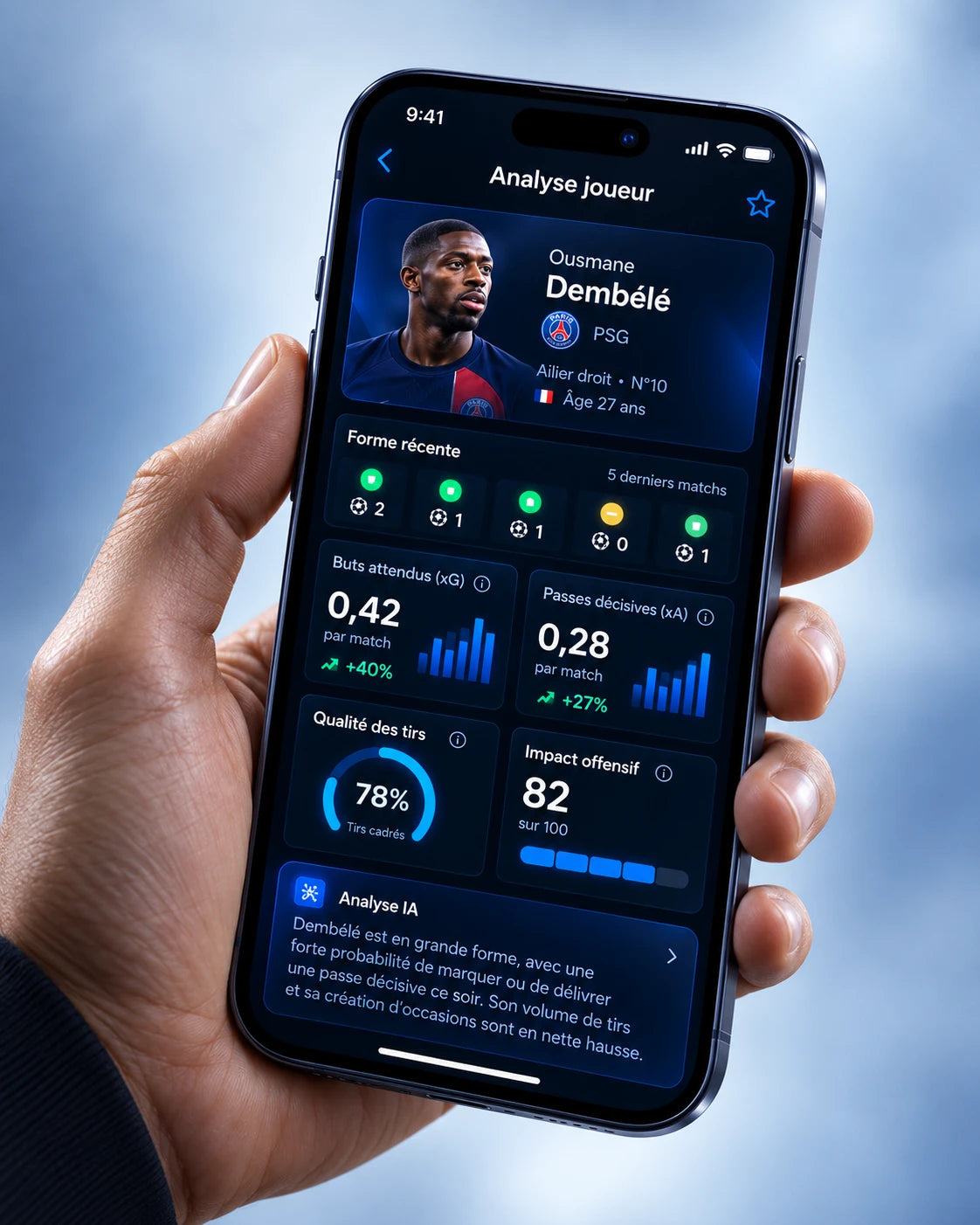
According to Opta's own explanation, its model uses machine learning trained on close to a million shots from 40 competitions between 2018-19 and 2021-22. It takes in distance and angle to goal, the goalkeeper's position, how clear the goal mouth is, pressure from defenders, the type of shot (foot, header and so on) and the pattern of play (open play, free kick, corner). A penalty gets a fixed value, 0.79 in that model. Other providers, such as StatsBomb (Hudl), build their own models, so values differ from one source to another.
Invented example: a team has three shots in a match, worth 0.45, 0.10 and 0.05. Its xG for the match is 0.60. It could easily score two goals, or none: xG describes the quality of the chances, not the scoreline.
Two uses that should not be confused
- Observed xG: worked out after a match (or over several), it sums up the chances created and conceded. It is a diagnostic tool.
- Expected goals in a forecast: before a match, a model estimates how many goals each side should score on average. Those values are then used to work out probabilities (win, draw, number of goals).
The first describes the past; the second is an assumption about the future, built from the first and from other factors.
“Over/under 2.5 goals”
This line separates games with three goals or more (“over 2.5”) from games with none, one or two (“under 2.5”). A match total is a whole number, which is why the line sits at half a goal: it rules out a tie.
A classic approach treats goals as a Poisson process. Here, for illustration and with invented totals, is what that simple approximation gives:
| Expected total goals (invented) | Under 2.5 goals | Over 2.5 goals |
|---|---|---|
| 2.2 | about 62% | about 38% |
| 2.7 | about 49% | about 51% |
| 3.2 | about 38% | about 62% |
Even at 2.7 expected goals, it is close to a coin toss. The model is a simplification: Dixon and Coles (1997) showed that scores such as 0-0 and 1-1 turn up more often than a model with independent scoring would suggest.
“Both teams to score”
This indicator (often shortened to BTTS) is “yes” if each side scores at least once. Using the same approximation and invented averages of 1.6 expected goals for team A and 1.1 for team B, the chance of A scoring at least once is about 80% and for B about 67%. Treating the two as independent gives roughly 53% for “both teams to score”. Again, independence is a simplification: an open game pushes both sides to score, while a cagey one can stop both.
The limits worth knowing
- xG does not measure the result. As Opta points out, the team with the higher xG does not necessarily deserve to win: the metric measures chance quality, not the expected outcome of the match.
- Models differ. Two providers can give different values for the same shot. Compare figures from the same source.
- xG only sees shots. Dominance without shooting, tactical context or a changing scoreline are not directly captured.
- Penalties are simplified. Most models give them one fixed value.
- Luck still matters. Goals are rare: over a few games, the gap between actual goals and xG can be large without meaning much. A bigger sample is more reliable.
- The 2.5 line and “both teams to score” rest on assumptions. They depend on the expected goals estimated for each side, which are themselves uncertain.
Using them sensibly
Look at averages over several games rather than one. Separate home from away. Combine xG with context: absences, what is at stake, style of play. Treat percentages derived from xG as orders of magnitude, not as facts.
About Prediction AI
Prediction AI is an AI-powered predictive sports analysis platform: for a football match it presents estimated probabilities (including over/under 2.5 goals and both teams to score) together with the facts behind them and their limits. Take a look at the Prediction AI plans. An estimate is an estimate, never a certainty.
Further reading
- The Factors That Influence a Football Match and How to Weigh Them Cautiously
- The Prediction AI Method: How a Match Analysis Is Produced, in Full Transparency
- How to Read a Win, Draw or Loss Probability (1X2)